
By Billy Morrison | AAA Fence
Table of Contents
Key Takeaways
-
This guide explains how modern automatic gate-opener systems work, why prompt service matters, and what to look for in a trustworthy repair partner like AAA Fence.
-
The single most common reason for commercial automatic gate repair is a worn or failing gate operator: the motor, gearbox, and control board that drive the cycle wear down with thousands of openings each month.
-
When a commercial automatic gate repair gets delayed, an entire business can grind to a halt, leaving deliveries, employees, and customers stranded at the curb.
-
For dependable commercial automatic gate repair, our veteran and family owned crew brings honest workmanship and decades of local experience to every job.
What Is Commercial Automatic Gate Repair?
Commercial Automatic Gate Repair: A Guide for Florida Businesses
When a commercial automatic gate repair gets delayed, an entire business can grind to a halt, leaving deliveries, employees, and customers stranded at the curb. For Florida property owners, a dependable entrance is a matter of security, safety, and everyday operations. This guide explains how modern automatic gate-opener systems work, why prompt service matters, and what to look for in a trustworthy repair partner like AAA Fence.
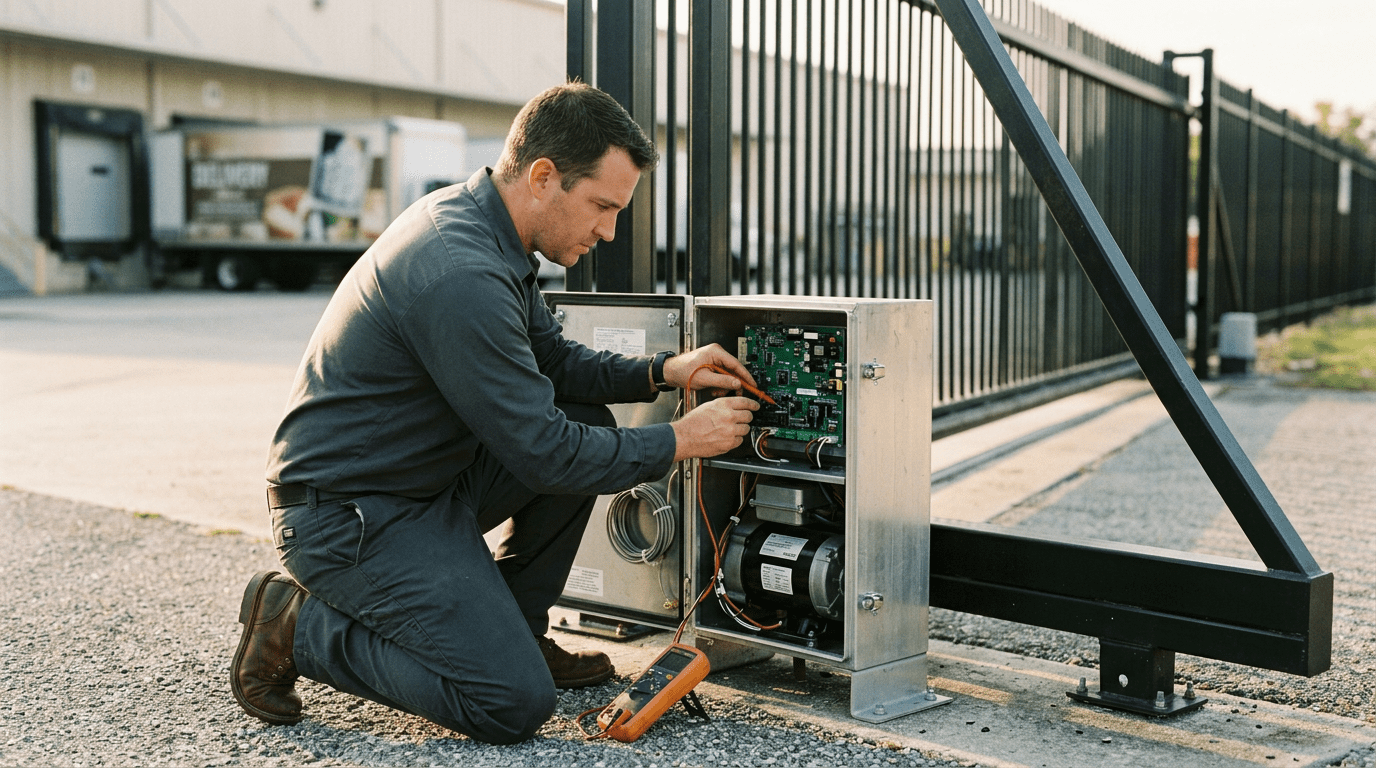
So what does commercial automatic gate repair actually involve? At its core, it is the diagnosis and restoration of the motorized operators, control boards, safety sensors, and hardware that move a powered entrance gate. These systems guard parking lots, warehouses, and gated facilities, so a single failure can compromise both access control and perimeter security. Because these are electro-mechanical devices, regular upkeep is essential: according to DASMA gate safety guidance, your automated gate system requires periodic maintenance and testing. That is why prompt, professional service can matter even more for a business than for a typical residential driveway. A commercial gate often cycles many times throughout the day, and downtime translates directly into lost productivity. Understanding how automatic gates work, and how a powered operator integrates with your broader commercial fencing, helps owners catch early warning signs before a minor fault becomes a costly emergency.
What Causes Commercial Automatic Gates to Fail?
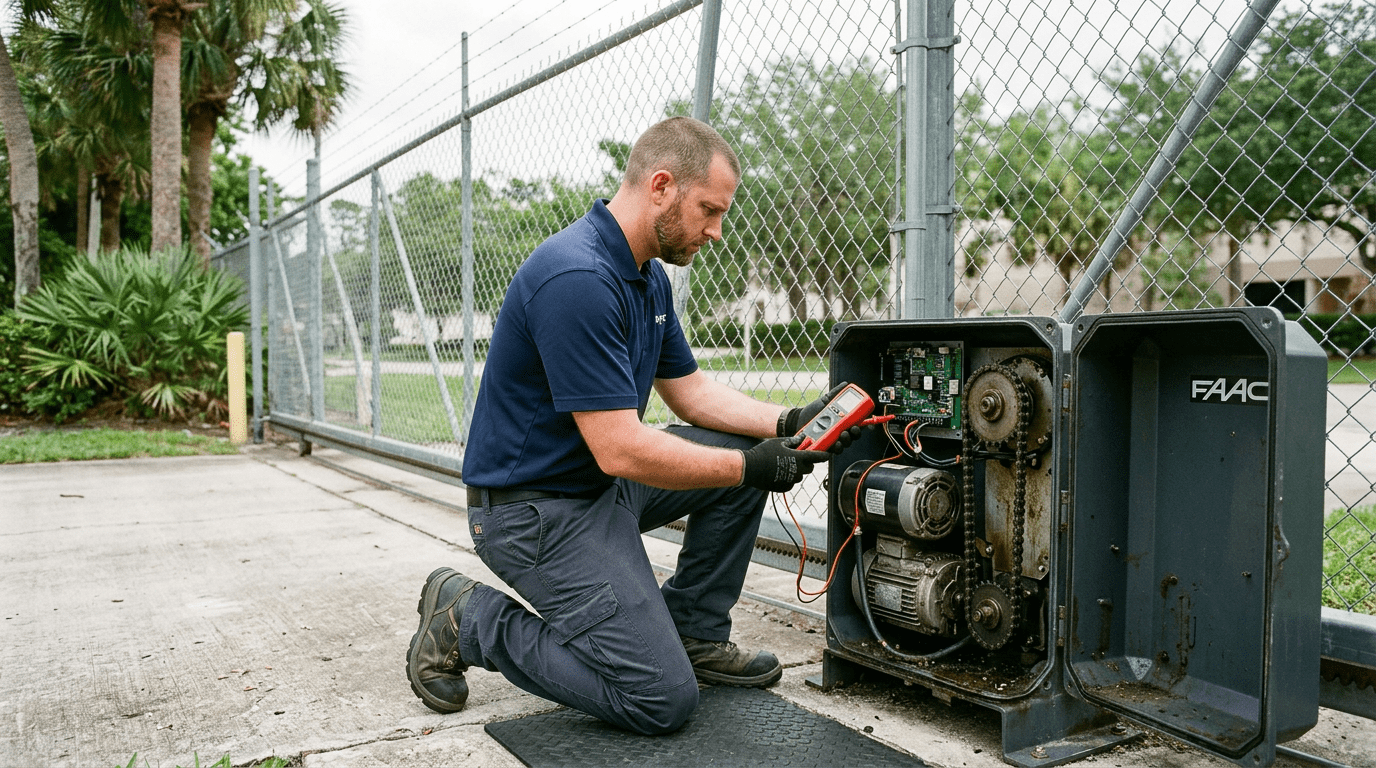
Why do commercial gates that once ran flawlessly suddenly stutter, stall, or refuse to close? In most cases, the trouble traces back to a handful of predictable culprits. The single most common reason for commercial automatic gate repair is a worn or failing gate operator: the motor, gearbox, and control board that drive the cycle wear down with thousands of openings each month.
Misaligned tracks, bent or rusted rollers, and loose chains follow close behind, especially along Florida's coast where salt air accelerates corrosion. Failing entrapment sensors and photo eyes are another frequent fault, often showing up as a gate that reverses for no reason or stops halfway.
Warning signs are usually audible and visible before a full breakdown: grinding or squealing noises, sluggish travel, jerky movement, and remotes or keypads that respond inconsistently. Understanding your electric gate opener helps you spot these symptoms early.
At AAA Fence, we often see commercial automatic gate repair needs escalate when small issues go ignored. Serving Daytona Beach, FL, Volusia County, FL, and Flagler County, FL, our licensed team diagnoses the root cause rather than masking the symptom.
Which Warning Signs Demand Immediate Attention?
Some symptoms signal more than routine wear. A gate that fails to reverse when it meets an obstruction, sparks or a burning smell from the control box, or a unit that no longer holds its position can pose real safety risks and should be shut down until inspected. When an aging operator needs full replacement rather than a quick fix, flexible financing options help commercial property owners restore secure access without delay.
Rule of Thumb: Don't Wait on Warning Signs
-
Two or more recurring symptoms, like grinding noise plus a gate that reverses on its own, usually point to a failing component rather than simple sticking.
-
Acting early on these signs keeps a minor commercial automatic gate repair from turning into a costly operator replacement.
-
Request a free estimate today to have a licensed AAA Fence technician diagnose the root cause.
|
Common Cause / Issue |
Warning Sign to Watch For |
Relevant Safety Requirement |
|---|---|---|
|
Worn operator or failed entrapment sensor |
Gate will not reverse on contact, or reverses with no obstruction |
UL 325 requires at least one independent primary and one independent secondary means to protect against entrapment. |
|
Exposed or worn sliding-gate rollers |
Visible gaps at the rollers; grinding where the gate meets the post |
Per DASMA safety tips, under ASTM F2200 all exposed rollers in sliding gates must have covers or guards to protect pinch points. |
|
Outdated or non-compliant gate construction |
Gate predates modern safety upgrades and lacks a listing mark |
ASTM F2200 states automated vehicular gate systems shall comply with this specification and be compliant with UL 325. |
-
4 – UL 325 usage classes for vehicular gate operators, Class I to IV
-
2 – Independent entrapment safeguards UL 325 requires, one primary plus one secondary
-
2 sec – Maximum time a compliant sensor takes to stop or reverse a gate on contact
-
6 ft – Minimum distance DASMA recommends placing gate controls from the gate
What Happens During a Commercial Gate Repair?
So how does a commercial automatic gate repair actually unfold, from the first service call to the final safety test? Rather than guessing at the cause, an experienced crew follows a deliberate sequence that isolates the real problem before any parts are swapped. That order matters, because a sticking gate can stem from a worn roller, a failing operator, a misaligned sensor, or a tripped control board, and each points to a different fix.
At AAA Fence, we treat the gate as a complete system instead of a single broken piece. A technician inspects the mechanical hardware, the operator, the safety sensors, and the power supply together, so the work restores both reliable access and the protection your property depends on. Understanding this workflow helps commercial property owners ask sharper questions, plan around downtime, and recognize honest, transparent service when they see it. The numbered steps below show what a careful repair visit typically involves.
-
Start with a service request: a commercial automatic gate repair begins when the property owner reports the symptom and can request a free estimate, so a technician assesses the gate on site rather than over the phone.
-
Diagnose the full system, checking the operator, control board, safety sensors, hinges or rollers, and power supply to pinpoint the actual fault instead of the surface symptom.
-
Confirm safety compliance: before the gate returns to daily use, verify that the operator is listed to a recognized safety standard for vehicular gate systems.
-
Repair or replace the failed parts, correcting worn rollers, damaged tracks, faulty sensors, or a tired operator with manufacturer-approved components.
-
Test every safety function by running the gate through full open and close cycles, confirming the reversing and sensor protections respond and that travel is smooth and quiet.
-
Plan ongoing care: like any electro-mechanical system, an automated gate needs periodic testing, so schedule a service visit whenever problems recur.
Get Your Gate Back in Service
A malfunctioning entrance gate slows your operation and puts security at risk, so the smart next step is calling a team you can count on. For dependable commercial automatic gate repair, our veteran and family owned crew brings honest workmanship and decades of local experience to every job. Reach out to our team and let us get you moving again.
Frequently Asked Questions
How much does commercial automatic gate repair cost?
Pricing for commercial automatic gate repair can vary depending on the gate type, the part that failed, and the access controls involved. A worn roller or a misaligned sensor is generally a smaller job than replacing an operator motor or control board. Because every property is different, a professional inspection is the most reliable way to budget the work. You can request a complimentary estimate to get pricing matched to your site.
What are the most common issues that need repair?
Why do automated gates fail? The usual culprits are misaligned tracks, worn rollers and hinges, faulty safety sensors, dead batteries, and power or wiring faults. Access-control trouble is common too, so a balky keypad or remote often points to a simpler fix; our gate opener remote guide explains how those components work. Diagnosing the true cause early helps prevent a small fault from sidelining your entrance.
How often should a commercial gate be serviced?
Like any electro-mechanical system, gates wear over time. According to industry gate safety guidance, an automated gate system requires periodic maintenance and testing to keep operating safely. Many facility managers schedule routine professional service on a recurring basis, with high-traffic entrances often needing more frequent attention. Regular upkeep typically catches small problems before they become costly failures.
Can you handle commercial automatic gate repair for every gate type?
Most commercial sites use slide, swing, or cantilever designs, and each has its own failure points. Experienced technicians can typically service automatic entrance gate systems across these configurations, from the operator and sensors to the panels and hardware. The key is matching the repair to the specific operator and access-control setup on your property.
Is it safer to repair or replace an aging gate operator?
That depends on the operator's age, condition, and safety features. If parts are still available and the unit meets current safety expectations, a targeted repair is often the practical choice. When an older operator no longer protects against entrapment or repeatedly fails, replacement can be the safer long-term investment. AAA Fence can help you weigh both paths honestly so you invest where it counts.